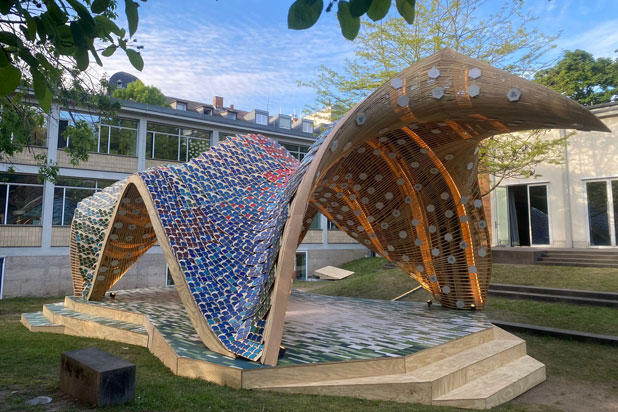
As part of the celebrations for Frankfurt Rhein-Main's designation as World Design Capital 2026, ICEX is promoting a unique architectural installation that aspires to become a symbol of the European debate on the role of architecture in social, urban, and economic transformation. The lightweight structure, which reinterprets the architectural method developed by Antoni Gaudí, will transform the garden of the Cervantes Institute in Frankfurt, the project's host and cultural partner, into a dynamic cultural space open to the public in the coming months.
The initiative is part of ICEX’s strategy to support the internationalization of Spanish companies as a benchmark for design, material culture, and advanced construction solutions. In this regard, the pavilion places materiality at the heart of the architectural discourse, presenting it not only as a construction solution, but as an expression of identity in one of the leading international forums for contemporary design, with high visibility among institutions, specifiers, and European markets.
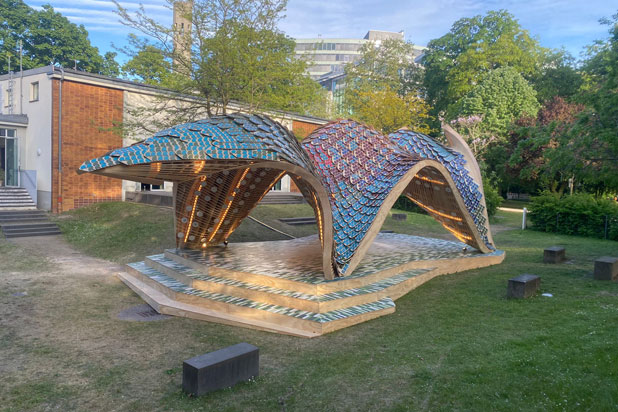
Designed by architects José Ramón Tramoyeres and Javier Cortina, founders of ggstudio, and built by Volúmenes and Vareta, the project proposes a new model of cultural architecture: demountable, reusable, and itinerant. With an organic, continuous geometric design, the modular structure assembled from wood and ceramic permits international touring.
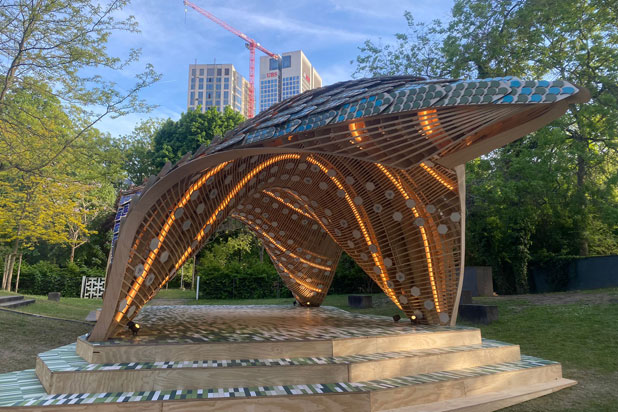
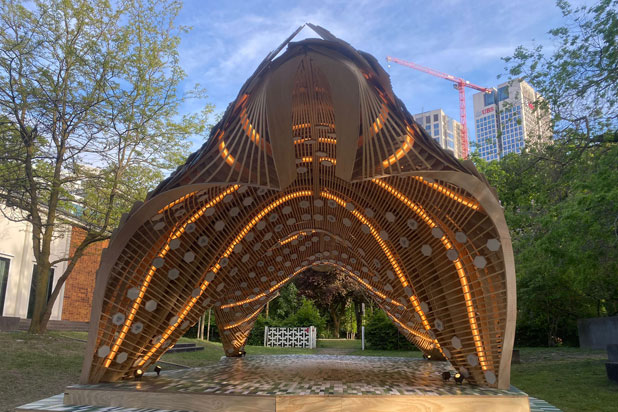
Beyond its architectural dimension, the installation is conceived as an exercise in cultural and economic diplomacy that demonstrates the Spanish creative and industrial ecosystem’s ability to respond to contemporary challenges and develop innovative solutions in the field of construction. The wooden structure features a hybrid skin composed of ceramic solutions, which provide texture, strength, and depth, and textile components that make it possible to modulate light, ventilation, and the relationship with the surrounding environment. The combination creates a dynamic envelope, particularly significant at night thanks to an integrated low-energy lighting system.
The dynamism and innovative capacity of the construction sector in our country is demonstrated through the collaboration of companies such as Emedec , responsible for the supply and machining of wood; Francisco Simó Pinturas, in charge of protection systems; Natucer, Decocer and Cevica, which have contributed customized ceramic solutions with highly expressive finishes; Idelightec representing the lighting sector and Lastra & Zorrilla in the textile field, completing a multidisciplinary collaboration that shows the quality and knowledge of the Spanish industry.
Gaudí as a Contemporary Construction Method
The architect approaches Antoni Gaudí’s methodological legacy from an operational and contemporary perspective. The project does not reproduce historical forms; instead, it explores structural and constructive principles linked to geometry, material efficiency, and the relationship between form and system.
The installation brings this logic to today’s European context through a lightweight, modular, demountable, and reusable structure that combines Mediterranean material culture with technical innovation. In this regard, the project aligns with the principles of the New European Bauhaus by integrating sustainability, construction precision, and the social dimension into a model of circular and reversible cultural infrastructure.
Social Dimension and Cultural Activation
The space is not conceived as an enclosed pavilion, but rather as a permeable architecture in dialogue with the park and encourages the free movement of visitors. Thus, during its stay in Frankfurt, it will host a dedicated program that will activate the Instituto Cervantes garden as a cultural venue open to hosting institutional presentations, business meetings, cultural activities, small-scale concerts, and initiatives linked to the promotion of design and contemporary architecture.
The project includes a specific analysis of circularity and mobility that assesses the installation’s life cycle, its dismantling, and its international transfer. This approach makes it possible to define criteria for its installation in different urban contexts and strengthens the reversible and reusable nature of the architectural infrastructure.
The official opening will take place on April 29 and will bring together institutional representatives, the specialized press, architects, designers, and industry professionals. The event will include institutional participation, an artistic performance, and a networking meeting in the vicinity of the installation. Following its opening, the space will host, through the end of June, an ongoing program of cultural, professional, and business activities aimed at strengthening dialogue between Spain and Germany and generating new opportunities for collaboration in the fields of design, architecture, crafts, and the creative industries.
Spanish design will also be presented in Frankfurt on May 27 with an exhibition and a Spanish design event
With this action, ICEX consolidates its role as a key player in the international dissemination of Spanish talent, creativity, and industrial capacity at one of the leading international forums dedicated to contemporary design.